Rapid and Safe Trajectory Planning over Diverse Scenes through Diffusion Composition

Wule Mao1, Zhouheng Li1, Yunhao Luo2, Fangguo Zhao1, Lei Xie1
1 Zhejiang University 2 University of Michigan
IECON 2026
contact: zh_li [at] zju [dot] edu [dot] cn

Teaser

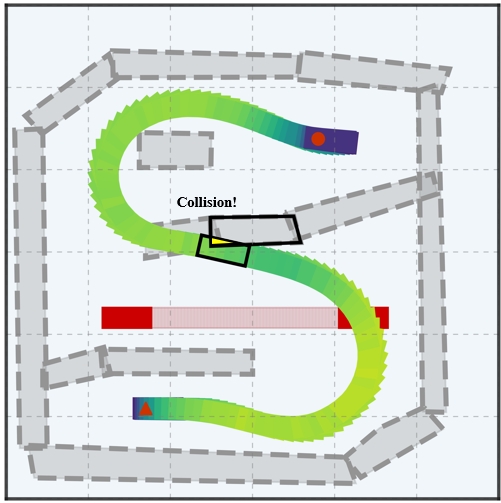
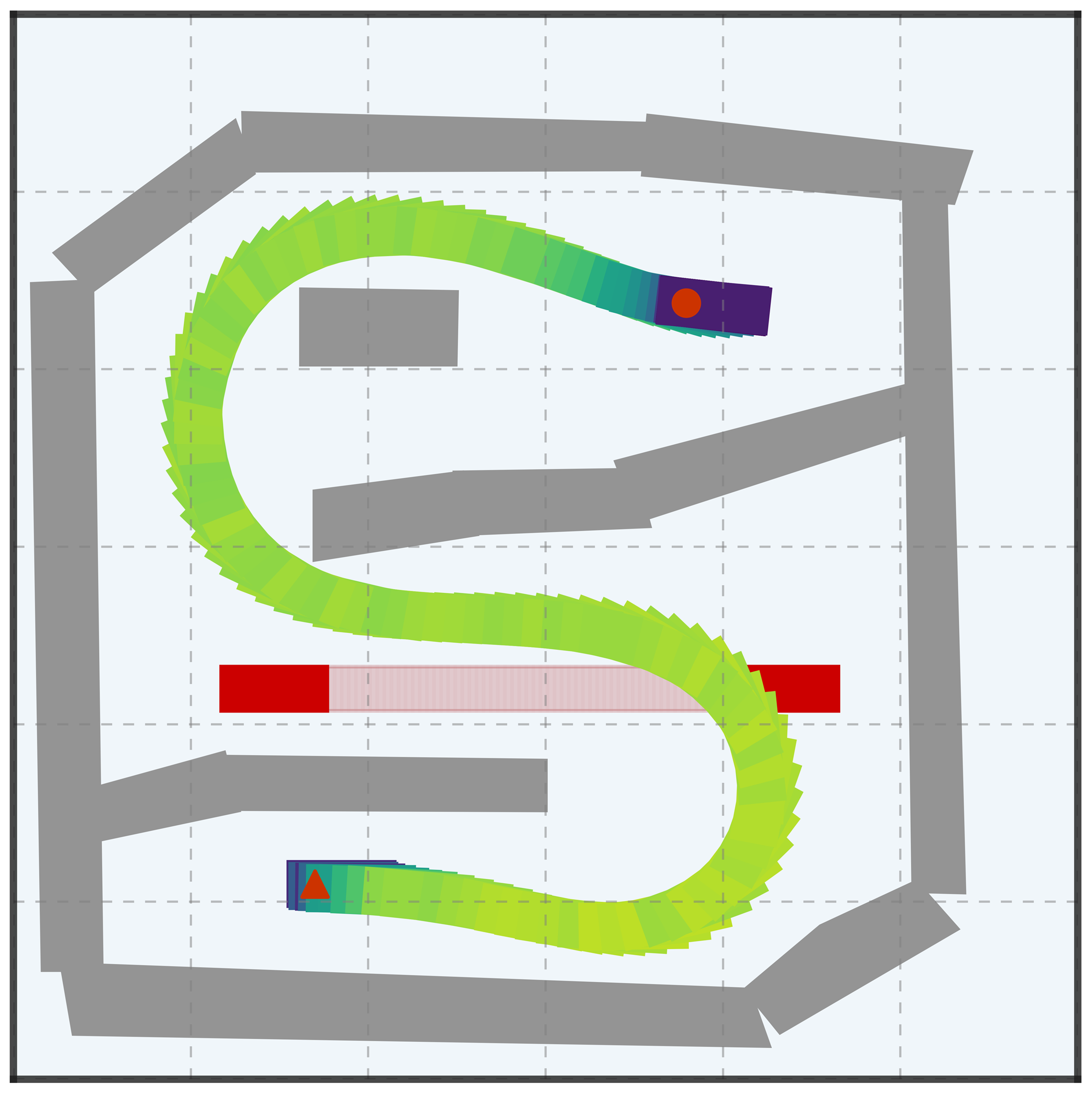
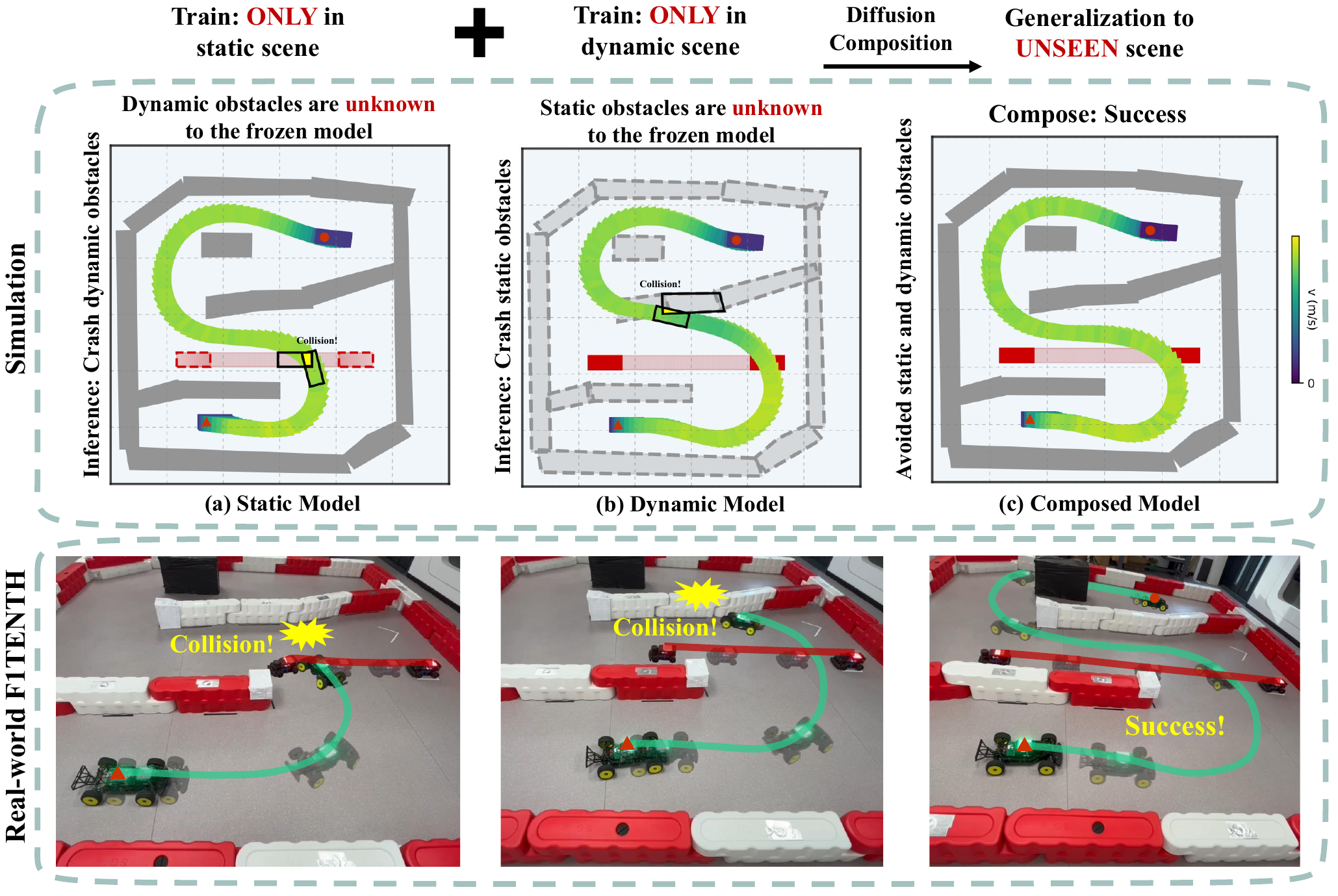
Diffusion Composition Enables Efficient, Safe Planning with Practical Real-world Performance. An individual diffusion model cannot ensure safe trajectory planning in out-of-distribution scenarios, whereas composing multiple energy-based diffusion models can achieve test-time generalization. Dashed boxes indicate obstacles that do not exist during training. Validation on the F1TENTH platform shows that trajectories planned by the composed diffusion model offer excellent safety while maintaining computational efficiency, demonstrating effectiveness for practical real-world applications.

Abstract

Achieving safe, efficient, and kinematically feasible planning in dynamic environments remains a significant challenge, as planners must simultaneously handle moving obstacles, sensor uncertainty, and strict motion constraints. To address this problem, we propose an energy-parameterized diffusion planning framework that learns a conservative energy field to realize safe and stable generalization across diverse scenarios. The energy-parameterized diffusion formulation enables flexible integration of multiple constraints, allowing the planner to generalize to previously unseen environments without retraining. To ensure real-time safety during deployment, we further incorporate a lightweight safety filter that enforces safety and kinematic feasibility constraints in real-time. Additionally, we develop a scene-agnostic, MPC-based data generation pipeline to produce large-scale, dynamically feasible training trajectories. In simulation, the proposed method achieves real-time performance with a mean planning time of 0.21s and a low planning failure rate of 0.57%. Real-world experiments on the F1TENTH platform further validate the effectiveness of the proposed framework. Under sensor uncertainty in previously unseen dynamic environments, the planner consistently generates collision-free trajectories, which remain safe after being tracked by a simple controller, maintaining a mean obstacle clearance of 0.26 m, demonstrating strong robustness and practical applicability. Project page: https://rstp-comp-diffuser.github.io.

Real-World Validation of Individual Static Model

replay

replay
replay

replay

replay
replay
This paper presents a rapid diffusion-based trajectory-planning framework that integrates real-time localization and perception with energy-parameterized generative models. By performing state-based denoising over low-dimensional representations, RSTP reduces the noise dimension and improves planning efficiency while retaining diffusion models' generative capability for smooth, kinematically feasible trajectory candidates.

Real-World Validation of Composition for UNSEEN Scenes

Static Diffusion Model replay

Dynamic Diffusion Model replay
Composed Result replay
This model composition approach ensures collision-free trajectory planning in unseen scenes for safety. The proposed method can make safe test-time decisions to generate safe behaviors, such as decelerating to avoid obstacles, thus allowing collision-free trajecoty planning for diverse scenes without retraining.

Composed Scene 1 - view 1:

Initial Pose: [0.86, 0.03] replay

Initial Pose: [2.73, 0.32] replay
Initial Pose: [3.03, -0.07] replay

Composed Scene 1 - view 2:

Initial Pose: [0.86, 0.03] replay

Initial Pose: [2.73, 0.32] replay
Initial Pose: [3.03, -0.07] replay

Composed Scene 2 - view 1:

Initial Pose: [0.82, 0.07] replay

Initial Pose: [2.76, 0.47] replay
Initial Pose: [2.79, -0.11] replay

Composed Scene 2 - view 2:

Initial Pose: [0.82, 0.07] replay

Initial Pose: [2.76, 0.47] replay
Initial Pose: [2.79, -0.11] replay


The Performance of Model Composition in Simulation

Weights of composition - [Dynamic Model, Static Model]:  
Static Model

Dynamic Model

Composed Result
Effectiveness of Models Composition and Sensitivity of Compositional Weights. The composed model can safely generalize to unseen scenes when appropriate compositional weights are selected, achieving collision-free trajectory planning.